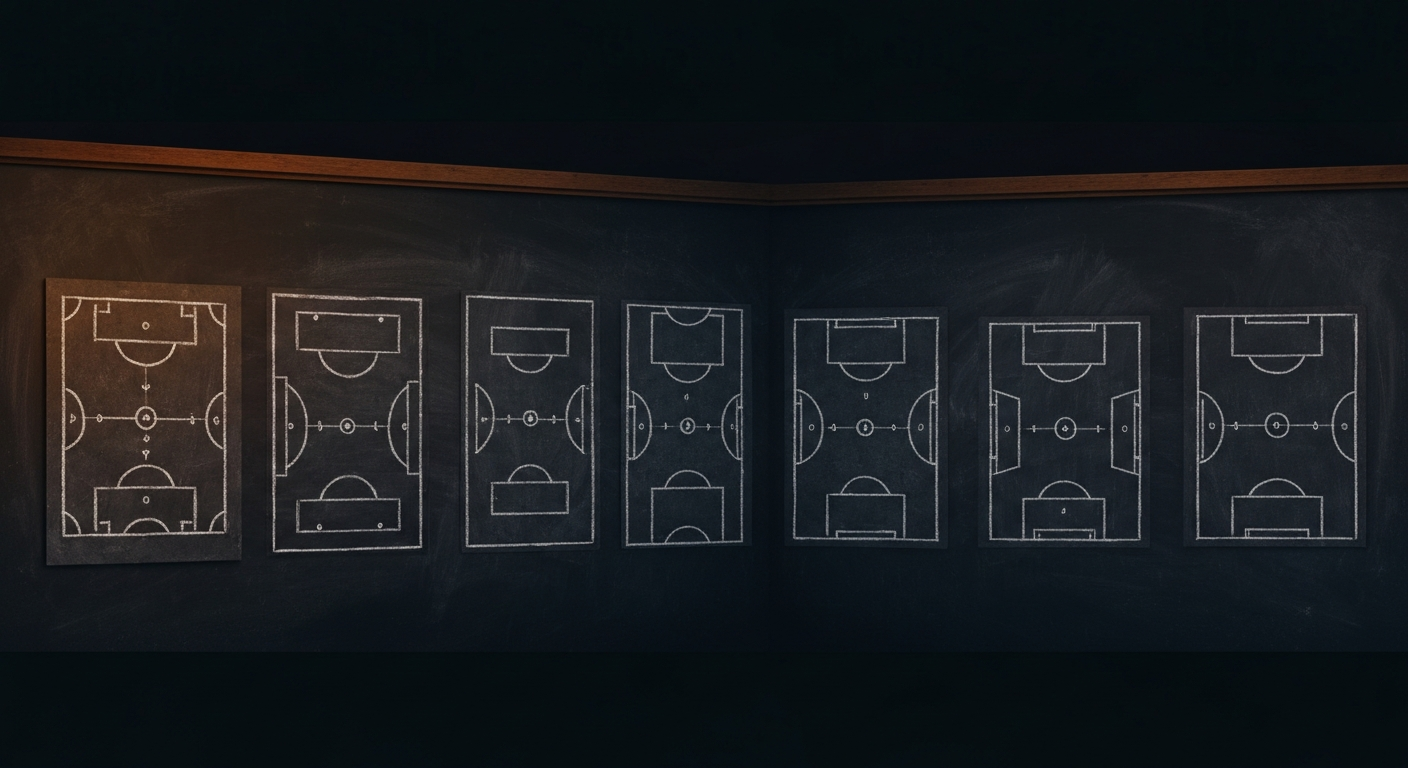
World Cup Tactics Through History: From WM to Possession-Pressing
Every World Cup gets a tactical signature, the formation, the press, the system that wins it. Eight tournaments, eight tactical revolutions.
Until a Formation Emerges
Every generation has won the World Cup with a different system. The trophy is also a record of what football looked like at that moment. Eight tactical revolutions, eight champions. Let's start from the beginning.
1930–1954: The WM Era
The formation at the first World Cups was 3-2-2-3. The name: WM, three centre-backs, two holding midfielders, two inside-forwards, three attackers. Uruguay 1930. Italy 1934 and 1938. Uruguay again 1950. West Germany 1954. All of them played the same system.
So for 24 years, football refined a single shape. The more disciplined side won. Nothing else was on offer.

1958–1970: Brazil's Years
Brazil in 1958 changed everything. Pelé was 17 years old. The formation was 4-2-4, the opposite of what came before, with the attacking centre of gravity dominant. In 1962, the same. By 1970, it was 4-3-3: midfield triangle, three forwards, two full-backs who actually defended.
The 1970 Brazil side is still the benchmark. If xG had been calculated back then, the average would have been above 3.0 per match. No modern team creates chances at that rate.
In short, Brazil taught something else too: attack is not defence. They are two different disciplines living inside the same game.
1974: Cruyff and Total Football
The Netherlands in 1974 lost the final. But they won the future.
Johan Cruyff and manager Rinus Michels built something: Total Football. Every outfield player could play every position. When the team was off the ball, they pressed as a unit. The offside trap was not accidental. It was tactical. Final lost to West Germany 2-1.
But today, open any modern system, the root leads back to Cruyff. Guardiola's Barcelona, Klopp's Liverpool, Tuchel's Chelsea. All children of the Netherlands 1974.
1980–1990: Catenaccio Returns
Italy 1982 won with catenaccio, the door bolt. Five at the back, a libero inside them, defensive solidity, counter-attack precision. Paolo Rossi scored six goals across the knockouts.
West Germany 1990 moved the same direction. Through the 1980s, football answered the question "what do we do?" with "concede fewer goals". Excitement fell. Trophies came.
2002–2006: Pragmatism Wins
Brazil 2002 played 3-5-2 with Ronaldo, Rivaldo and Ronaldinho. Wing-backs both attacked and defended. Ronaldo scored twice in the final against Germany, cup collected.
Italy 2006 under Marcello Lippi returned to the deep block. Defensive approach once again. Italy won again.
Football had started asking "how little risk can we take?" all over again, until Spain arrived.
2008–2014: Tiki-Taka and Spain's Decade
Spain won the 2010 World Cup by passing it.
Vicente del Bosque carried Guardiola's Barcelona principles, possession, short passes, instant ball-recovery, false-nine, into the national team. The result: Euro 2008, World Cup 2010, Euro 2012. Three major titles in a row, all with the same 4-3-3 / 4-2-3-1 tiki-taka structure.
A generation learned a single system. Then a generation got bored of a single system.
Germany 2014 won with the next evolution: counter-pressing. Joachim Löw's side combined the Spanish passing game with high press after turnovers. The Brazil semi-final, 7-1, the moment counter-pressing went mainstream.
Germany's national team borrow directly from Jürgen Klopp's Borussia Dortmund. The principle behind the gegenpress Klopp built between 2008 and 2015 is simple: lose the ball, get it back within six seconds, attack again before the opponent's structure settles. Klopp later turned the same idea into Liverpool's most successful press-and-go system of the 2018-22 period.
2018–2022: Counter-Pressing and Defensive Density
France 2018 won with structure. Didier Deschamps built a 4-2-3-1 defending with two compact lines, then transitioning through Mbappé.
Argentina 2022 under Scaloni used 5-3-2 when chasing, 4-3-3 when pressing. Messi's final World Cup campaign contained at least three different formations, Scaloni broke the "single system" rule.
2026: The Possession-Pressing Hybrid
The 2026 World Cup arrives with a new orthodoxy: the possession-pressing hybrid. Modern systems combine Guardiola-style positional play with Klopp-style high press. Spain, France, Germany, England, Brazil, all running different variants.
Who will win? The team whose pressing and positional structure is aligned in the same midfield.
Goalence's model measures team strength (Pi-Ratings). But it cannot measure the system. A system can lose a match and win a tournament. A team can play no match brilliantly and still stubbornly walk its way to a final.
The World Cup remains beautiful for exactly this reason, the system, more than the talent, determines the champion.
Frequently asked questions
Which tactical system has won the most World Cups?⌄
Brazilian-style 4-2-4 / 4-3-3 (3 cups: 1958, 1962, 1970), followed by the various WM variants (5 cups before 1958).
Did Total Football ever win a World Cup?⌄
Directly, no — Netherlands lost the 1974 and 1978 finals. But every modern system traces lineage back to Cruyff's principles.
What is the 2026 tactical favourite?⌄
Possession-pressing hybrid: positional play with high counter-pressure. Spain and France field the most refined versions in the tournament.