From 1-10 to 4-2-3-1: 150 Years of Football Tactics Evolution
From kick-and-rush to tiki-taka, here's how football's shape became today's 4-2-3-1, step by step.
A 150-Year Story
How did football become what it is today? Think about it for a moment: the 4-2-3-1 formation has been in common use for over seventy seasons. Pep Guardiola's false-nine idea shaped an entire era through Messi alone. Klopp's gegenpressing changed a continent.
But none of this existed at the start. There was one goalkeeper and ten outfielders. Everyone chased the ball. There were no formations.
Let's go back to the beginning.
The Start: 1-10 and Chaos (1860–1880)
In football's earliest years, there were no formations. One keeper, ten outfield players, rush the ball. Before Sheffield FC (1857) and the Cambridge Rules (1863) arrived to standardise things, every team played to its own count.
The game was called kick-and-rush. Wherever the ball was, everyone was there too. Passing did not exist. Dribbling and long balls were the only weapons. Football was a battlefield: whoever ran hardest won.
The 2-3-5 Pyramid: The First System (1880–1925)
The Scots invented combination play, passing plus positioning, and beat the English with it. The 2-3-5 Pyramid emerged: two full-backs, three midfielders, five forwards.
The shape was attack-heavy because the 1866 offside rule still required a defender to stand behind every forward. You could start up front, you could crowd the front line, you could attack from the off.
This system remained the world standard for 45 years. Half a century.
WM (3-2-2-3): Chapman's Revolution (1925–1953)
In 1925 the offside rule changed, now only two defenders were needed instead of three. Attack suddenly became dangerous in a new way.
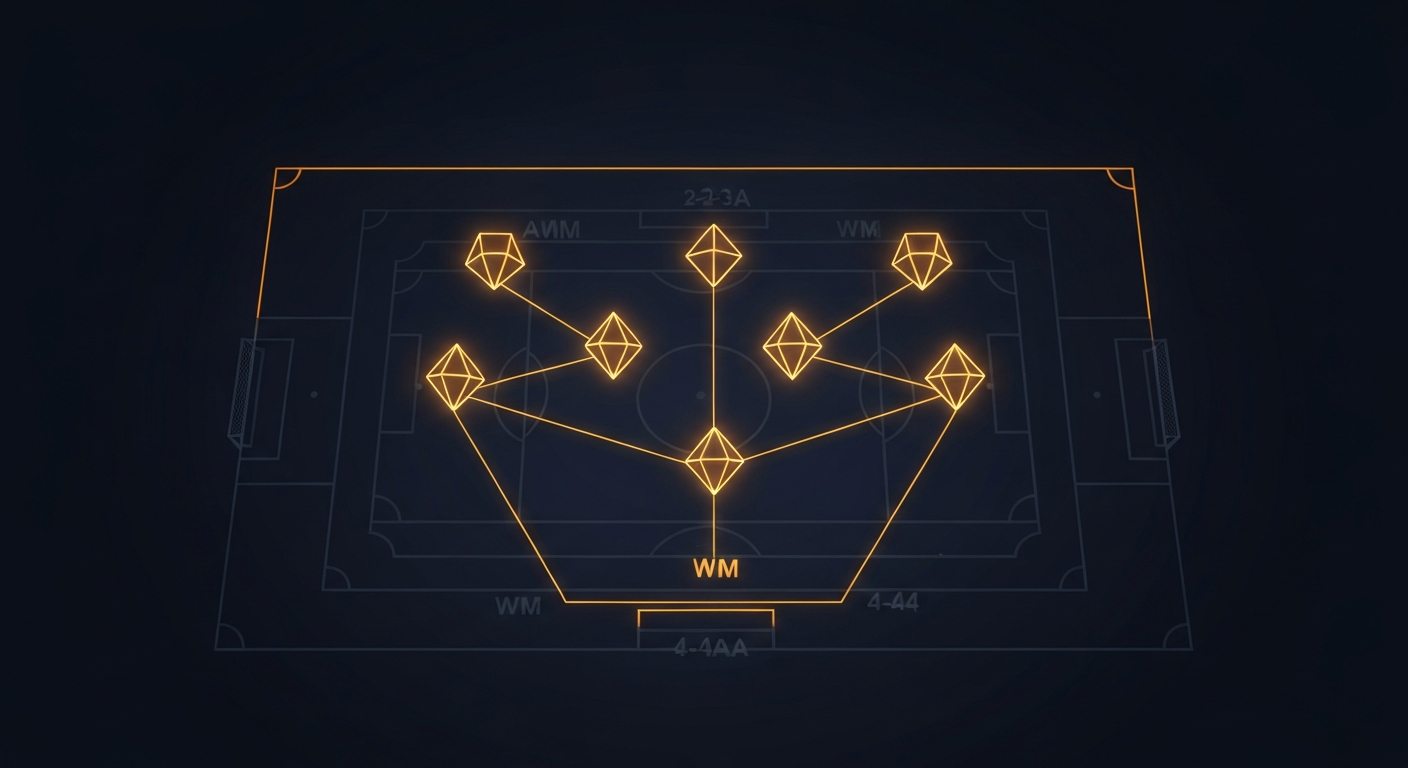
Arsenal manager Herbert Chapman found the answer: the WM. A 3-2-2-3 structure that, read from above, looks like the letters W and M. Defence solidified. Arsenal dominated England through the 1930s.
So one rule change gave birth to a new formation. The same thing happens every time the offside law is touched.
4-2-4: Brazil's Revolution (1958)
1958 World Cup, Pelé's Brazil arrived with 4-2-4. Four at the back (two full-backs, two centre-backs), two midfield links, four attackers.
The attacking power was extraordinary. Vicente Feola brought the system. Brazil won the cup. The 4-2-4 redefined world football for a decade.
Catenaccio: The Italian Wall (1960s)
Helenio Herrera carried catenaccio to the championship at Inter Milan. The Italian word means door bolt. Five at the back, a libero inside them, tight man-marking, rapid counters.
Inter won back-to-back European Cups in 1964-65. The system worked. Was it boring? That was debated, but the debate was academic. The ones winning the cups weren't arguing.

Total Football: The Cruyff Era (1970s)
Rinus Michels's Ajax and the Netherlands invented Total Football. Every player on the pitch could play every position. A fluid 4-3-3 where players constantly swapped roles.
Johan Cruyff was the star. The Netherlands lost the 1974 World Cup final, but the system laid the foundation for all of modern football. Every current system carries Cruyff's DNA: Guardiola, Klopp, and Tuchel are all children of that lineage.
4-4-2: Order and Discipline (1980s–2000s)
Arrigo Sacchi's AC Milan dominated Europe with 4-4-2 zonal marking (1988-90). In England, Manchester United under Ferguson and Arsenal under Wenger made 4-4-2 the standard.
High pressure, compact defence, fast transitions. Two wide midfielders, two forwards in attack, four at the back, four in midfield. Clear division of labour, clear zones of movement.
4-2-3-1: The Modern Era (2000+)
Vicente del Bosque's Real Madrid (2002) and José Mourinho's Chelsea (2004) popularised 4-2-3-1. Two defensive midfielders, a number ten, a striker. The ideal balance.
Goalence data: across the 31 leagues we track, 4-2-3-1 is the most common starting formation of the 2025-26 season. That means roughly roughly six out of every ten teams in the world take the pitch in this shape.
Gegenpressing: Klopp's High-Press Revolution (2008–2020)
While possession football was at its peak, Jürgen Klopp at Borussia Dortmund (2008-2015) and then Liverpool (2015-2024) built something different: gegenpressing, counter-press within six seconds of losing the ball.
The formation was secondary (Klopp used 4-3-3, 4-2-3-1, even 3-4-3). The principle was what mattered: win it back high, attack again before the opponent's structure settles, let the press itself create the chances.
By the late 2010s every elite club had adopted some version of it. Press intensity became just as tactical a variable as formation.
The Next Step: False 9 and Positional Play
Pep Guardiola's Barcelona (2008-12) shredded the framework with false 9 (Messi dropping deep) and inverted wingers.
Today's Manchester City and Bayer Leverkusen use transitional systems, 3-2-5 in attack, 4-2-4 in defence, where the shape on the pitch changes three or four times within a single minute depending on match state.
Formation numbers are no longer enough. Positions are dynamic now.
Today
150 years ago it was 1-10 chaos. Today every team reshapes its formation three or four times inside a match.
What's the next revolution? Perhaps AI-assisted positional coaching. Perhaps another rule change. The answer, as always, is buried in the laws of the game. Just as the 1866 offside rule gave birth to the 2-3-5, some small tweak in the future will produce a shape no one has seen yet.
A Cruyff line to close with: "Football is in the head; the feet only execute." That sentence has been true for 150 years.
Frequently asked questions
What was the 1-10 formation?⌄
There was no formation. One keeper plus ten outfielders chased the ball as a pack — kick-and-rush football, played in the 1860s.
Who invented the WM formation?⌄
After the 1925 offside rule change, Arsenal's Herbert Chapman built the 3-2-2-3 shape. Viewed from above it looks like the letters W and M — hence the name.
What is catenaccio?⌄
Italian for "door bolt". A 1960s 1-4-3-2 defensive system built around a sweeper, tight man-marking, and lightning counters, popularised by Helenio Herrera at Inter Milan.
What is the most common formation today?⌄
4-2-3-1. Goalence tracks 31 leagues; 4-2-3-1 is the starting shape in 58% of them in the 2025-26 season.